
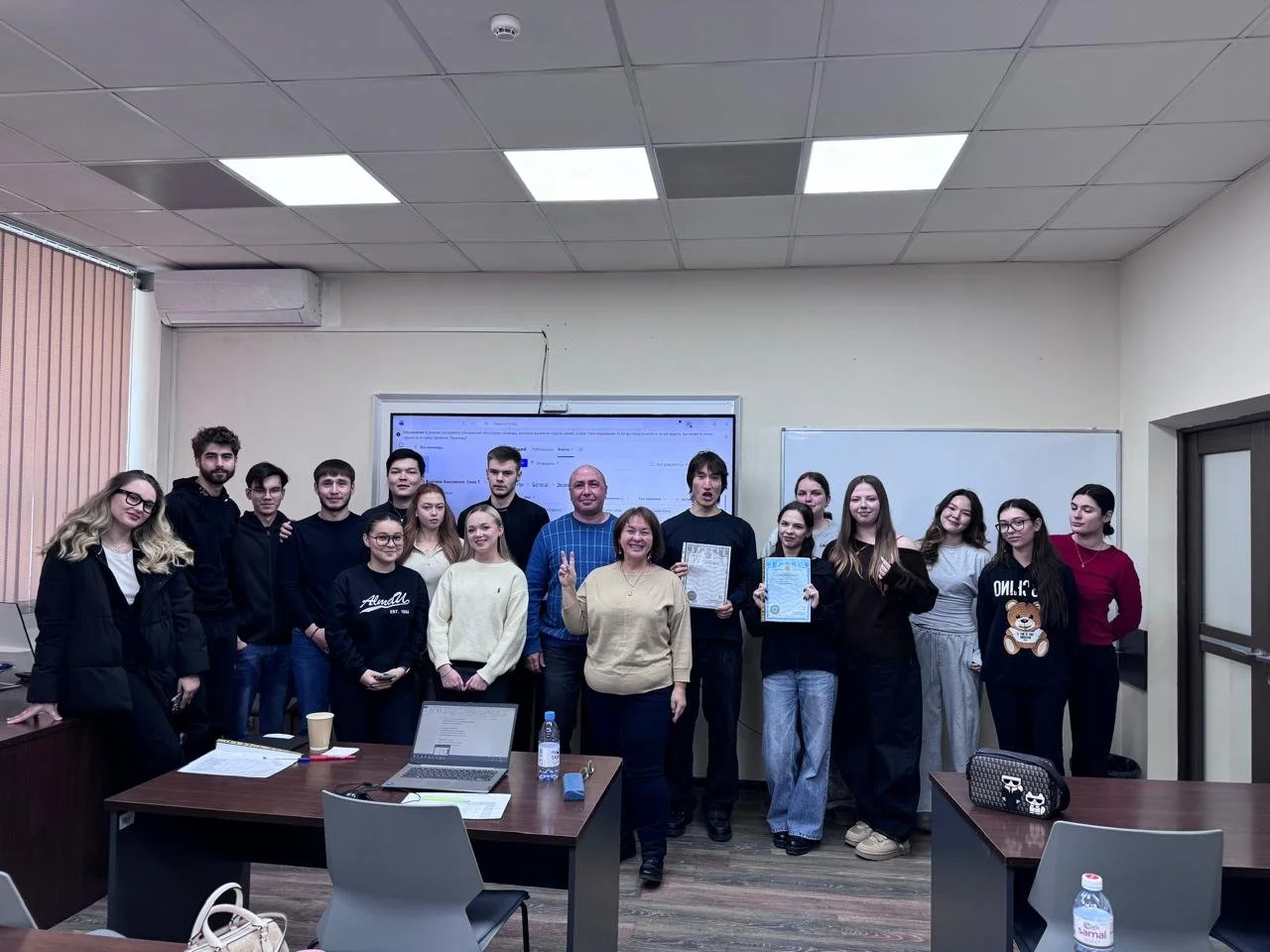
Tatyana Sapa (center) with her students.
When Tatyana Sapa found herself at a pivotal stage in the development of the 1C-Sapa and Slava KVC group of companies, she faced a series of complex challenges: evaluating and organizing new ideas, shaping a long-term growth strategy, and making decisions amid uncertainty. Yet alongside these business challenges emerged another, equally important goal.
As a Professor of Practice at AlmaU, Tatyana taught courses on ISO 20700 for consultants pursuing CMC certification, as well as courses on succession planning in family businesses. Her ambition extended far beyond simply sharing knowledge. She wanted her students not only to understand complex management concepts but also to find inspiration in them and apply them in their own lives and careers.
“I realized that deep expertise alone does not guarantee audience engagement. You need to be able to transform knowledge into stories that people remember and that inspire them to think and act.”
It was at this point that she turned to Tatyana Soldatenko, whom she had previously met through their work with the CMC Central Asia chamber. Their relationship quickly evolved into a trusted partnership built on regular conversations, discussions of real-world challenges, and ongoing feedback.
Their work focused on storytelling, public speaking, and refining Tatyana’s teaching methodology. Together, they examined lecture structures, techniques for maintaining audience attention, ways to communicate complex concepts through real-life examples and case studies, and strategies for strengthening her confidence as a speaker.
Over time, the changes became noticeable not only to Tatyana herself but also to her students. Her lectures became more structured, logical, and practical. Course materials gained greater coherence, while the use of storytelling helped create deeper emotional connections with students and significantly increased engagement.
One of the most meaningful outcomes was an internal transformation. Tatyana became more confident as an educator and learned to approach uncertainty with greater ease, viewing growth as an ongoing journey rather than the pursuit of a single end goal.
A major milestone on that journey was submitting a proposal to speak at the “New Information Technologies in Education 2026” conference. If accepted, preparing for the presentation will become the next stage of her collaboration with her mentor.
Today, Tatyana continues the mentoring relationship and considers her mentor an important professional guide who helps her stay focused on what matters most.
“For me, mentorship is not about receiving ready-made answers. It is about asking high-quality questions that help you better understand yourself, your business, and the context around you. Real value emerges when both people are genuinely invested in the process of growth.”
Tatyana’s story demonstrates that sometimes the most important step forward begins not with finding solutions, but with the willingness to learn, rethink your experience, and remain open to new opportunities for growth.
